Tuesday, November 22, 2011

Biologische Obstspezialitäten: Swiss organic fruit farming the traditional way


Using the internet to document my orchard obsessions has allowed me to discover fruity wonderlands in far away lands. Recently, I was contacted by Helmut and Monika who manage such a place on the southern shore of Lake Constance in Switzerland between Romanshom and Arbon. They've generously donated some photos of their farm, and I think you will agree with me that it looks like quite a place!


It's a rare example of a commercial fruit farm of the most traditional form, with 550 trees of apple, pear, plum and cherry set over 10.5 hectares. The trees are standards, planted on vigorous rootstocks and allowed to grow to full height. These are the type of orchards that are so rich in biodiversity and are a 'priority' habitat for conservation in the UK. It has been a family run enterprise for 120 years, but the age of some of the trees demonstrates a tradition of fruit growing that stretches back much further.


This photo shows one of their fantastic old perry pear trees, a type of fruit tree that is particularly beautiful after a hundred years of growth. Sadly trees like this are becoming increasingly rare in the UK.


This tree is an apple variety called 'Gravenstein' that Heklmut and Monika make a single variety sweet cider from. You can see the poles they use to prop up the heavily laden branches preventing breakages in the Autumn - a technique I haven't yet seen employed in Britain. Tender loving care!


This is another apple called 'Muolener Rosen'. Apparently is a variety that is largely unknown but produces a very healthy vigorous tree that crops productively in alternate years. Many cider varieties show this cropping pattern in Britain, especially in unpruned traditional orchards.


Harvest time in the orchards. The farm is totally organic, with the main income coming from sales of fresh fruit and sweet cider in the farm shop. They also supply apples and pears to a local cider factory. They also supply to retail outlets in Bern and Basel.


They produce other single variety ciders, such as 'Sauergrauech', 'Leuenapfel' and 'Taffetapfel'. (Just when you thought you were making headway in the labarinthine world of fruit varieties, hey!).


A pleasing traditional orchard scene with the next generation of trees beautifully complementing the more venerable characters! If only more orchards in Britain had such a continuity of horticulture and habitat.


Autumn colours remeniscent of James Stanley's orchard near Ebrington in Gloucestershire.


I'm not sure what the winters are like in this part of Switzerland, but presumably they are pretty hardcore. Ideal for killing off pathogens in the trees and preventing disease outbreaks.


This amazing tree is a another perry pear. A fruit-growing research station near Zurich came down and aged this tree at 300 years old! The variety is called 'Wagner's Wildbirne' that is good for fermenting and drying too. Apparently its found nowhere else in Switzerland. You get trees approaching this age in Britain but I have never seen one with such wide spreading branches. She's a BEAUTY!


They have also developed their own variety called the 'Emmy' apple which is exclusively available from this farm. Thats the young tree in the foreground here. Helmut and Monika explained that they included this photo to illustrate that with vigorous 'seedling' rootstocks (e.g. M25) it is a fallicy that it takes years and years for trees to start producing.

All in all, I feel an orchard holiday in the making!

Friday, October 28, 2011

The surviving orchards of Ebrington


Looking down towards Chipping Campden from one of the only old cherry orchards left in this part of Gloucestershire. In this area, it's better to focus on what is left to preserve rather than dwell on what has been lost.


This is James Stanley, a farmer who lives locally to me. He looks after several fantastic old orchards that I spotted via Google Earth. Today he was kind enough to take me on a guided tour of his orchards and the weather couldn't have been better for it. This tree is a Blenheim Orange. I've encountered a few old ones like this - they're impressive trees and always recognisably by the gnarly bark. It's a tasty late dessert apple variety found in c. 1740 as a 'gribble' by a gardener, Mr Kempster, on the boundary wall of Blenheim Palace in Woodstock. (A 'gribble' is an apple tree that has germinated naturally from a pip in the countryside, in case you were wondering!).


It is a classic traditional orchard, with all the trees widely spaced on standard rootstocks that has enabled the tress to grow large enough to cope with cattle grazing for many years. James was telling me how he used to pick from all the trees using tall ladders and sell the fruit locally. Sadly now there is no market for the varieties except intermittent custom from local cider-makers. Hooray for cider, again!

This is an interesting tree. James has a whole row of these, with spectacular claret fruit. James' father used to call these "Devlins".


Looks can be deceiving though, as they taste pretty cardboardy and apparently only really sold during the war when everyone was short on options.


Beautiful perry pear trees again, reminiscent of an orchard in Bledington and my new friends Helmut and Monika's farm in Switzerland.


Because it has been so dry and sunny recently the trees have kept their leaves really well - look at the colour of this perry pear!


Sadly this orchard has a real issue with 'generational bias', like many traditional orchards. If they no longer have a commercial use then there is no incentive to 'gap up' when trees die and an orchard with no young trees will slowly fade away...


Is this Ebrington's last plum orchard?

Tuesday, October 11, 2011

Reinette d'Orleans: tasting the ultimate dessert apple with Barry Juniper


There's nothing like spending a few afternoons trespassing in orchards to clear the smoke of the city from your lungs! I have been missing-in-action doing a masters course in London, but now I'm back wandering the groves...


I had previously mentioned a mysterious dessert apple called the Orleans Reinette (or Reinette d'Orleans). Back in Cambridge, Professor John Parker, the then Director of the Botanic Gardens, had recommended this as the best apple he had ever tasted. Many others agree. Orleans Reinette was first described in 1776 and is now grown throughout Europe but it remains in Britain as something of a rarity. It has proven to be illusive to track down. With apple season fully underway, last Tuesday I tagged along to a filming event with one of the world authorities on apples in his own private orchard.


This is Barry in his orchard in Wytham in which he has collected around 130 different apple varieties. Barry is an Emeritus reader in plant sciences from Oxford University and author of 'The History of the Apple'. He is doing his thing for a Dutch film crew that are producing a series called 'Paradise' that is all about the future of food (it is the brainchild of a very interesting scientist, director and writer: Louise Fresco).


In 1929, the famous pomologist Edward Bunyard described how '...it seems to come from the Low Countries, where we first meet with it in 1776. Its brown/red flush and glowing gold do very easily suggest that if Rembrandt had painted a fruit piece he would have chosen this apple. In the rich golden flesh there is a hint of the Ribston flavour, much of the Blenheim nuttiness, and an admirable balance of acidity and sweetness which combine, in my opinion, to make the best apple grown in Western Europe....as a background for an old port it stands solitary and unapproachable.'


It's an unbelievable apple. (It stands solitary AND unnapproachable!) Really low acidity and fantastic subtle undertones of vanilla that emerge as you chew. It's also cracking with a mature (= runny) English goat's cheese a drop of Sauternes. Those slices in the background are Brownlee's Russet - notice how the Orleans Reinette does not go brown (oxidation) when its flesh is exposed to the air. Go out and find one!

Tuesday, July 20, 2010

Pump up the bramley - sky lanterns, fire and elderflower champagne


Last weekend I had a party in the 1920s orchard at Charingworth. I invited the people I work with in the market garden and a few other friends and orchard helpers. Three of the guests were cider-makers so we were well supplied with cider and perry, and also got to try out my elderflower champagne for the first time. 'Too yeasty' is often the verdict with this kind of venture, but actually it was really good. Young, fresh, very fizzy and refreshing. A bit like me I hear you say? Ah gags!


A cheeky tribe of scrumpers, armed and dangerous! It takes some skill to get your face that muddy.

Orchards are great for camping as they never get too windy. I was pitched a little close to my hive of sleeping bees though.


It was the first time I had tried this back-to-nature minimalist fire pit design for the BBQ. It worked really well, and I would recommend aligning it with the direction of the prevailing wind to maximise air-flow. We cooked Cumberland sausages, burgers, and spicy 'Hungarian Hot Wax' peppers stuffed with coconut rice. Use British charcoal if you can - it burns so much better and the woodland management involved in producing it benefits many species. I like to think Ray Mears would have loved it, although someone brought tin foil and I know he hates that.


Everyone knows that there is nothing quite as entrancing as fire, and when you combine it with the gaping mouth of a drunken man it becomes a special pleasure.


No ultra-hip orchard knees-up would be complete without a sprinkling of sky lanterns (or should that be a twinkling?). I'm sure the NFU would have something to say about that, but apparently the wheat is not ripe enough to burn yet and life is too short anyway. Our ones didn't have any metal wire in them making them 100% biodegradable and safe for cows etc.

Saturday, July 3, 2010

Orchards and beekeeping with Charlie the jackdaw


On Thursday I was invited to a special orchardy event hosted by the Farming and Wildlife Advisory Group (FWAG) at Day's Cottage. My beekeeping guru Tanya was one of the main speakers, covering all aspects of the the longstanding relationship between orchards and bees. In this photo she is showing us the different components of an occupied hive (although it does look suspiciously like some kind of cult meeting). I also gave a short talk about orchard restoration - hold onto your hats people!


Beekeeping is crammed full of interesting facts and props and this makes it ideal for demonstrating. Look at the amazing glass-fronted display hive on that table. We all had to try to identify six different honeys by taste. They were: Cotswold garden honey (Tanya's), Salisbury Plain honey (florally diverse), Sicilian Eucalyptus honey (monofloral), English heather honey (bleak?), oil seed rape honey (lurid?) and New Zealand manuka honey (TCP++). I got two right but was impressed by the range of flavours.


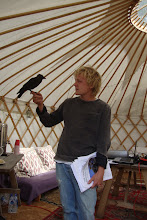
Here is Dave Kaspar, chairman on the Gloucestershire Orchard Group, and that chap on his shoulder is Charlie. Dave and Helen Brent-Smith have been raising him on cat food and he's now two months old. When I first arrived he came out of nowhere and landed on the FWAG lady's head and she freaked out, thinking he was a wild bird. In the other photo Dave is doing a demonstration of budding with a plum variety called Rivers' Early Prolific. Budding is another method of reproducing varieties, like grafting, only it's quicker and is done in the summer.


Here is the pommace left over from an earlier juicing, and see how it is studded with freshly germinated apple seedlings. Back when most farms had a press and made their own cider for the labourers, this stuff was often either fed to the pigs of spread on the fields. Farmers used this latter option as a way of generating new apple seedlings to use as rootstocks for established varieties. Every now and again one of these seedlings gave rise to a brand new variety, but sadly this source of new variation has been largely lost. Pips will not germinate unless they have been completely liberated from the apple flesh and 'scarified' by the cold of winter (or a fridge).


DEAD WOOD! THAT'S WHAT I'M TALKIN' ABOUT!


Here's Jonathan Briggs - you may recognise him from one of my previous posts - a mistletoe expert. He gave a fascinating talk all about this parasitic plant which is a key component of traditional orchard ecosystems. That sprig of mistletoe is emerging from an unusually thick branch. Day's Cottage is deep within mistletoe territory and it is abundant, but up in my corner of north Gloucestershire it is far less common and the nationwide distribution patterns are yet to be fully understood. I have had some success getting it established in Charingworth, but that's for another day...


Imagine this for a pub accessory. And look at his fantastic cool blue eye. Who's a good boy?! Jackdaws are corvids, a family that includes crows, jays and magpies, and they are very bright. They can use tools and have demonstrated self-awareness. Perhaps one day he will be tempted by the glint in your eye...

Related Posts with Thumbnails