Showing posts with label the 1940s orchard. Show all posts

Sunday, May 16, 2010

Bait hives for honey bees


My friend Tanya is a natural beekeeper- that is, one that does not use chemicals and tries to encourage as natural a life cycle as possible for her colonies. She has loaned me two bait hives, one for each of my orchards in Charingworth. Bait hives are the empty first story of a hive that has been used by a colony previously. Theoretically, the smell of residual amounts of propolis and wax attracts scout bees that are on the look out for a new home for a naturalised colony that is ready to swarm. This swarm then may colonise the hive, and as it grows you can gradually increase the size of the beehive to accommodate them. The bees will then help pollinate the orchard effectively, and you can harvest HONEY from them! Mmmm.


Have a look at this secret glade I made in the 1940s orchard last week using my strimmer. It is quite magical to be enclosed by blossoming trees on all sides.

Tuesday, March 16, 2010

It's spring and the birds are moving in...


Two hours ago I took this photo of a red kite flying over the 1940s orchard! What a sign of how successful the Chilterns re-introduction program has been. Indeed, whilst I was getting a bus to Gatwick airport last week I saw over fifteen of them when we passed down through Buckinghamshire towards London. In medieval times they were common in towns and cities where they fed on carrion and waste in the streets, rather like vultures do in other countries.


My funding has stretched further than anticipated and so I was able to direct Issac into the 1940s orchard for a spare day. Here he just concentrated in doing the chainsaw work I can't do on my own, such as raising the crowns and removing any large diseased branches. I saw a few yellowhammer down by the pheasant feeder where they always seem to hang out. It's a red list species due to recent population declines that are almost certainly due to the intensification of farming methods.


We have finished pruning the 1920s orchard now and its looking pretty amazing. The main job left is getting rid of the immense volumes of prunings that we have created. The offcuts are all very green and sappy and I have been agonising over the most efficient way of dealing with them. A mobile chipper is one option, but the prunings are quite hard to handle and I think the best option may be to make several large bonfires and leave the wood to season for five months before burning it all.

Tuesday, November 24, 2009

Heavy machinary in the Charingworth orchards


Last Wednesday my neighbour John Langston brought his tractor to the orchards to help me do some grass mowing. It was such a beast that we couldn't take it between the trees but we managed to cut a few more open areas that were beginning to succeed to scrub. Flailing can be a destructive process, but it is probably the best way of dealing with large areas of really rough grass and brambles. For that afternoon at least, the crunching sound of the flail carried by the wind really was the sound of progress!


The lowest of these three 'before and after' shots shows the 'meadow area' at the back of the lower (1940s) orchard. It has always had a bad dock infestation that has made farming this patch impractical. However, I believe that chemical fertilizers have not been heavily used here and as a result there are already patches of Birdsfoot Trefoil and Meadow Vetchling that flourish in summer. Flailing will hopefully encourage these and prevent blackthorn, buddleia and poplar saplings from becoming dominant. I plan to seed some areas where the tractor has exposed soil with a wildflower mix and see whether anything establishes.


Here is a clearing in the 1920s orchard that we also flailed. I am planning to do some replanting in this area before Christmas. I am currently tempted by the idea of a couple of Blenheim Orange (likes clay) and an Orleans Reinette (fantastic eater, apparently) and perhaps some bittersweet varieites for cider. They have to be on M25 rootstocks though as I want them to grow BIG!

Thursday, November 19, 2009

Checking the barn owl box in the lower orchard at Charingworth


On Tuesday my friend Freddie and I took a ladder into the lower orchard to retrieve a pulley from up in a tree. We also took the opportunity to have a peek into one of the two barn owl boxes we erected in the orchards one month ago. The photo on the right shows why its good to check the boxes when it's not the breeding season. I removed that pile of ivy (hat for scale) that had been crammed into the box by a wood pigeon or dove. Barn owls are unlikely to use a box that has been filled with debris and so a respectful amount of intervention is necessary to give them a hand.

Sunglasses were appropriate (a rarity for November!) as a precaution against the slim chance of us disturbing a grumpy tawny owl. Neither of us wished for the fate of Eric Hosking, 'the most celebrated British wildlife photographer of the 20th century' (Birds Britannica), who lost an eye when scratched by a territorial tawny he was photographing. He got a fantastic photo of the culprit for his pains though.


I also discovered that one of my neighbours, Louise, is well on top of the agenda as she has a fantastic box she erected two years ago. It has been checked and so far, no signs of owls. Having a range of potential nesting sites gives the birds some choice and flexibility, hopefully increasing the stability of any population that establishes locally.

Sunday, November 15, 2009

'Wild' honey bees in the lower orchard at Charingworth


Today I was in the 1940s orchard clearing brambles away from the fearsomely shrouded branches of tree 40. I found a surprisingly active colony of honey bees in the south facing base of one of the trees nearby. Honey bees are not actually native to Britain. There are 'feral' populations of the European honey bee, a domesticated form of the bee Apis mellifera that originated in eastern tropical Africa. Beekeepers and orchards have a long history of symbiosis, with the beehives traditionally brought into the orchard in late spring for the blossom. This way the pollination of the blossom is maximised, helping ensure a good apple crop for the farmer and lots of nectar for the bees to make honey with.


I remember that the cavity had had unoccupied combs in it last winter and has clearly been repossessed by the bees. The photo on the left shows this comb in November 2008, with the one on the right taken today. Honey bees are not doing well in Britain currently. They are suffering from a range of new diseases, including the parasitic varroa mite that has spread viruses throughout wild and captive bee colonies.


The press often deal with these issues rather clumsily, confusing the causes of the decline in feral honey bee populations with those of the truly native bumblebee (23 species) and solitary bee (~250 species). The basic reason for the decline in most of our true native bee species has little to do with diseases- agricultural intensification has removed the majority of our species-rich grasslands and thus there are no longer enough nectar-rich plants to support bumblebee colonies and solitary bees (this photo shows a unimproved lowland flood meadow near Bledington, with abundant clover and birdsfoot trefoil). A lack of appropriate nest site habitats is also probably a factor limiting some bumblebee and solitary bee species. I went on a bumblebee walk on Salisbury Plain in August and met Damian who is interested in all these issues and has his own charity dedicated to helping bees.

Sunday, October 18, 2009

Second barn owl box installed at Charingworth


The second barn owl box has now been installed about six metres up in a poplar tree overlooking the lower (1940s) orchard at Charingworth. Percy and Herbie can only stare up and dream of having such luxury accommodation. It took three evenings to get it done after a few complications...


The 'improved' design sporting a few modifications undertaken by my dad under the advice from the Barn Owl Trust website: 1) roofing felt for extra waterproofing; 2) a baton-to-baton attachment for increased strength (over the previous single bolt and keyhole attachment); 3) a small rim around the balcony to prevent young chicks falling off so easily. Should be interesting to compare the success of this box with the unmodified one in the other orchard...


Without the impressive upper body strength of my friend Angus, a new way of installing the box had to be thought up. Ideally you need three people and a long ladder. The basic method was:

1) attach a pulley into the tree above the height you want the box at, i.e. as high as feasibly possible,
2) attach a baton (with pre-drilled holes for bolts) horizontally (spirit level) onto tree at desired height,
3) build a net of rope (see photo above) and hoist the box up,
4) marry up the corresponding baton on back of box to the attached baton on tree, using pulley to hold the bulk of the weight of the box,
5) secure with bolts through both sets of holes, and
6) tea.


As you can see from the quality of this photo its probably best to give yourself lots of time to do this. We flirted dangerously with the twilight hours but it feels amazing to have got another box up.


The view from the box into the 1940s orchard. I had to do a fair amount of trimming to ensure the box entrance had a clean flightpath in. This is really important though- barn owls are very unlikely to use a box that they can't easily fly into because of obstructing branches.


I was also fantastically lucky yesterday. This is the ash pollard we have been keeping an eye on since I found pellets and feathers inside it. On a dog walk I decided to have another look up inside it and I saw a barn owl perched right at the top up against one of the hollow sides! I will give it some distance now as I don't want to disturb it. It doesn't look like there is enough of a platform in the tree for a pair of birds to breed in there so maybe it's only using this tree as a roost. Good news though.

Wednesday, August 5, 2009

National Trust visits Charingworth orchards

On a fairly damp Wednesday morning Kate Merry, the Orchard Officer for the National Trust, came to Charingworth for her first visit to the orchards. Grahame Fisher (owner), Kate and myself toured both the 1940s and 1920s orchards, braving soggy undergrowth to give Kate an idea of the sites. We also went through the budget of where the money is to be spent over the next year and a half. We have been awarded six thousand pounds to help fund the restoration pruning of all 85 standard and half-standard apple trees, along with bramble removal, strimming and replanting the gaps where trees have died. It was fantastic to finally have a meeting between our funding partner and the landowners.


from right: Kate Merry (National Trust), Grahame Fisher (landowner) and myself.


Kate, Grahame and one of the more stately trees in the 1920s orchard.

Wednesday, July 29, 2009

Inspecting a woodpecker hole


Can you spot the woodpecker hole?


I got up onto a friends shoulders to take this photo right into the hole. It was probably made by a greater spotted woodpecker or a green woodpecker which are both quite common in Britain, but always fairly spectacular to see. You can just see where it opens onto a rotten cavity above. This is an ideal bat roost. I knew about this hole in 2008 but the feathers around the rim indicate it was used this year for nesting, possibly by a smaller bird like a blue tit.

Tuesday, July 28, 2009

Strimming and scything for the National Trust visit

A compact team of three with various tools (some modern, some archaic) on Monday afternoon. We cut a path through the badlands of the lower orchard in preparation for the National Trust's visit next week. Hot but satisfying work followed by a well earned pub pint.


(from right) Will and Freddie, Gloucestershire locals and noble volunteers.


Saturday, July 25, 2009

A bat survey in the Charingworth orchards


This morning I went out into the orchards with my neighbour Andy (pictured above) to survey potential bat roosts. Andy is an ecological consultant and bat enthusiast and has an endoscope for looking into cavities. I had previously located 6 likely looking cavities where there were openings into upwards slanting internal spaces so we went and checked them out...


There are seventeen species of bat in the UK, and 3/4 of these can use trees as roosting sites, each with their own different preferences. They generally prefer roosts that are dark, fairly well insulated, dry, quite humid and away from potential predators such as rats. Finding summer tree roosts is very difficult in places like Gloucestershire due to the number of trees and the fact that buildings often provide more suitable sites. Common pipistrelle (Pipistrellus pipistrellus) is the commonest British bat and the most likely species for the orchard to have as a resident.


Andy using the endoscope to inspect a cavity in the 1920's orchard. Promising potential roosts had very little cobwebs across the entrance or inside as the presence of these is both a deterrent to bats and indicates that the hole hasn't had any animal traffic passing through. Droppings are another giveaway. Sadly we did not find any bats in the trees, but there is great potential for some of the hollow limbs to be used either infrequently by solitary males or for hibernation in the winter. Another survey has been scheduled!


Three examples of the many (9+) woodpecker holes in the orchards. These are also often ideal bat roosts. Noctule bats (Nyctalus noctula) and Daubenton's (Myotis daubentonii) have been known to roost communally in the rot holes that form above old woodpecker nests. Cobwebs in several of the ones we inspected suggested no-one was currently using them.

Friday, July 24, 2009

What's there? What's to be done? A management plan emerges...


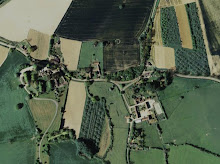
This is a satellite photo of the 1940's orchard that I have modified to show the positions and state of the trees more clearly. The numbering is completely arbitrary, but you can see there are 40 standard trees and three rows of bush-stock trees (in the centre). There are also several gaps and two standing dead trees, represented by stars. Yellow is for decrepit trees that have either tipped over, been felled to the base and are resprouting, or have split trunks from excessive regrowth weight. Blue is for the fourteen trees I pruned over this last winter. Tree 40 is haunted.


The larger 1920's orchard with 52 half-standard trees. This orchard is in better condition with only three decrepit trees (9 has a split trunk; 19 is standing dead as well as the un-numbered standing dead tree marked by a star). However, last winter I did not prune any of the trees here. I intend to focus on this older orchard with the grant money over the next two years and hopefully get all 50 remaining trees into good shape. Any gaps will hopefully be replanted too.

Sunday, July 19, 2009

The value of dead wood in orchards

One of the most interesting aspects of the two orchards is the abundance of standing and fallen dead wood- a nationally scarce habitat important for many rare insects, especially beetles. For example there are apparently around 700 species of saproxylic beetle found in mainland Britain. It will be exciting to see what turns up...


Piles of old prunings at the base of many trees combined with cavities provide a range of rotting wood habitats.


The somewhat tragic end to a vast apple tree's life in the 1940s orchard. Its all about allowing these fallen giants to decay gracefully.

Whole standing-dead trees. There are two of these in the 1940s orchard (another can be just seen behind the one in the foreground of this photo). These are particularly valuable as the wood rots from the inside out, providing a range of stages of decomposition. The rotting of this wood is facilitated by fungi and various micro-organisms that convert the wood into substances that can be digested by a range of insect species, since very few insects can actually digest dead woody tissues directly.

Friday, July 10, 2009

Strimming in the 1940s orchard


Did a spot of strimming yeasterday. Nice contrast between the head-height weeds and my newly cleared patch. Horseflies very bad this year.

Wednesday, July 8, 2009

Rick Stein and the BBC in the Charingworth orchards

An extract from an episode of Rick Stein's 'Food Heroes' series for the BBC. The slope he drives down is along the highest boundary of the 1940s Bramley orchard. This was filmed a few years ago when the orchards were still being managed commercially. The trees Margaret and Rick are picking from are the modern 'bush' style, with smaller semi-dwarfing root-stocks than the standard trees found in traditional orchards. This allows for picking and pruning without ladders, and as a result they are much more economical and are thus favoured by most commercial fruit producers. There are three rows of these trees in the centre of this orchard, flanked on both sides by much older, standard trees. However, apple trees on semi-dwarfing rootstocks are far less valuable for wildlife because they will never develop into the big old trees that have an abundance of valuable 'veteran tree' features such as rot holes and standing dead wood.

We can see in a snapshot some of the problems associated with traditional orchard conservation; primarily an active tension between the trend towards intensive management of younger, smaller trees for economically viable production and the long time periods and more extensive management that allows the orchard-woodpasture habitat to develop and become home to so many species.

Tuesday, July 7, 2009

Rot holes and cavities - a survey

For several days during November 2008 I surveyed every standard and half-standard apple tree to get an idea of the condition of the orchards. I measured the trunk height and circumference of the trees. I also counted and photographed each 'rot hole', 'cavity' and dead limb, since it is these veteran tree features that account for much of the habitat value in traditional orchards.


An example of a 'rot hole'. Great habitat for saproxylic invertebrates including the Noble Chafer, Gnorimus nobilis (a UK BAP species) and many species of fungi . And snails.


An example of what I would call a 'cavity'. It is more of an internal space than a 'rot hole' and often forms where a hollow limb or trunk is accessible through a hole in the bark. Good habitat for a range of cavity nesting birds and bats. You can see some fungal hyphae hanging down inside this cavity- it is in one of the oldest trees and has an entirely hollow trunk, along with several hollow limbs.


Out of a total of 34 healthy and 8 decrepit trees in the 1940s orchard, I found a total of 77 rot holes and cavities (thumbnails above). The average trunk circumference was 160 cm, measured below the lowest branch, illustrating the considerable size of trees in this orchard.


Out of a total of 50 healthy and 3 decrepit trees in the 1920s orchard I found a total of 164 rot holes and cavities. The average circumference was smaller though, at 143 cm. I think the reason this orchard has a greater density of ancient tree features than the one planted in the 1940s is due to the trees being older on average, as well as perhaps having been pruned more intensively being half-standard trees. More veteran tree features = more unusual habitat.


A resident of tree 28, 1920s orchard.

Related Posts with Thumbnails