Showing posts with label barn owl box. Show all posts

Tuesday, May 11, 2010

Preparing for the blossom...


After all the pruning activity of February and March, spring finally arrived and it was time to clear up the enormous volumes of prunings that had accumulated. Issac, Will and Freddie helped me spend a day consolidating the piles. Pruning offcuts are very sappy and extremely difficult to burn en masse. We decided the best option was to make several huge bonfires and leave the wood through summer to dry out before burning most of it. Any larger diameter pieces have already been stacked under each tree and on the orchard perimeter to slowly rot down.


In the middle of those two piles you can see one of the new trees I planted in March. This one is Ashmead's Kernel - an old Gloucestershire variety that makes excellent juice.


The exciting revelation of the tidy up was that for the first time we could see down the length of the avenues in the 1920s orchard. This photo was taken about a month ago and since then the grass has grown considerably. I have arranged for someone to come in with a topper and small cabin-less tractor and cut in on Saturday. After that I should have the photogenic combo of freshly cut grass and blossoming trees to spoil you with!


We also cleared out both of the barn owl boxes. I had seen the Jackdaws going into one of them, and it transpired that both boxes we full with sheep's wool and sticks from their nest-building attempts. Jackdaws fill the boxes with material and then build a nest right at the top. Barn owls will only ever colonise a box that is empty and they do not make a nest. I think it will be an ongoing task to keep them clear until they are colonised - but once barn owls are in residence they can use the same box year after year. I have also found this Jackdaw-proof owl box design which may be something to consider if you are thinking of installing one yourself...

Thursday, November 19, 2009

Checking the barn owl box in the lower orchard at Charingworth


On Tuesday my friend Freddie and I took a ladder into the lower orchard to retrieve a pulley from up in a tree. We also took the opportunity to have a peek into one of the two barn owl boxes we erected in the orchards one month ago. The photo on the right shows why its good to check the boxes when it's not the breeding season. I removed that pile of ivy (hat for scale) that had been crammed into the box by a wood pigeon or dove. Barn owls are unlikely to use a box that has been filled with debris and so a respectful amount of intervention is necessary to give them a hand.

Sunglasses were appropriate (a rarity for November!) as a precaution against the slim chance of us disturbing a grumpy tawny owl. Neither of us wished for the fate of Eric Hosking, 'the most celebrated British wildlife photographer of the 20th century' (Birds Britannica), who lost an eye when scratched by a territorial tawny he was photographing. He got a fantastic photo of the culprit for his pains though.


I also discovered that one of my neighbours, Louise, is well on top of the agenda as she has a fantastic box she erected two years ago. It has been checked and so far, no signs of owls. Having a range of potential nesting sites gives the birds some choice and flexibility, hopefully increasing the stability of any population that establishes locally.

Monday, October 26, 2009

Owl feathers


Three barn owl feathers I found in a roosting site inside a disused sheep shelter near my house. Barn owls have very soft feathers for flying silently and are vulnerable if they get too wet. They use a few familiar spots to retreat to if caught in the rain on a hunting trip. The last feather in the photo I found in our unused stable block- I think it may be from a tawny owl since I once disturbed one in there during the day.

Sunday, October 18, 2009

Second barn owl box installed at Charingworth


The second barn owl box has now been installed about six metres up in a poplar tree overlooking the lower (1940s) orchard at Charingworth. Percy and Herbie can only stare up and dream of having such luxury accommodation. It took three evenings to get it done after a few complications...


The 'improved' design sporting a few modifications undertaken by my dad under the advice from the Barn Owl Trust website: 1) roofing felt for extra waterproofing; 2) a baton-to-baton attachment for increased strength (over the previous single bolt and keyhole attachment); 3) a small rim around the balcony to prevent young chicks falling off so easily. Should be interesting to compare the success of this box with the unmodified one in the other orchard...


Without the impressive upper body strength of my friend Angus, a new way of installing the box had to be thought up. Ideally you need three people and a long ladder. The basic method was:

1) attach a pulley into the tree above the height you want the box at, i.e. as high as feasibly possible,
2) attach a baton (with pre-drilled holes for bolts) horizontally (spirit level) onto tree at desired height,
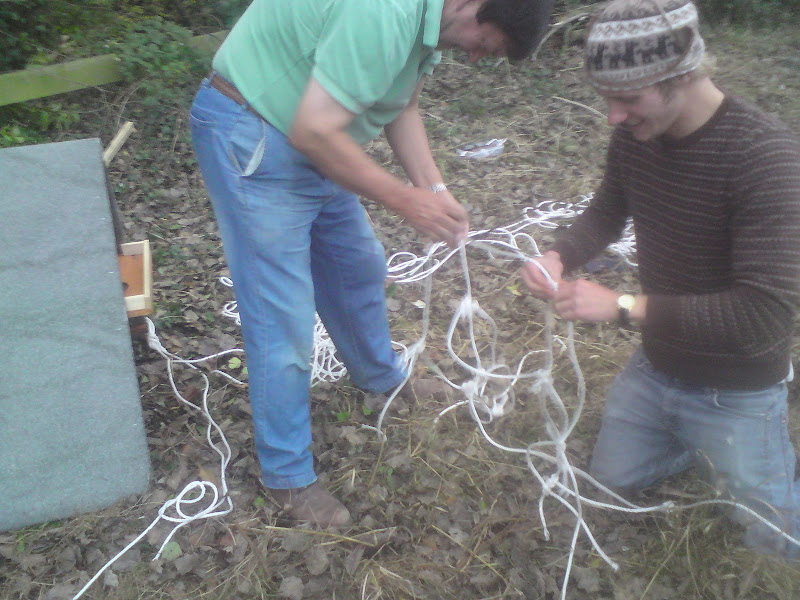
3) build a net of rope (see photo above) and hoist the box up,
4) marry up the corresponding baton on back of box to the attached baton on tree, using pulley to hold the bulk of the weight of the box,
5) secure with bolts through both sets of holes, and
6) tea.


As you can see from the quality of this photo its probably best to give yourself lots of time to do this. We flirted dangerously with the twilight hours but it feels amazing to have got another box up.


The view from the box into the 1940s orchard. I had to do a fair amount of trimming to ensure the box entrance had a clean flightpath in. This is really important though- barn owls are very unlikely to use a box that they can't easily fly into because of obstructing branches.


I was also fantastically lucky yesterday. This is the ash pollard we have been keeping an eye on since I found pellets and feathers inside it. On a dog walk I decided to have another look up inside it and I saw a barn owl perched right at the top up against one of the hollow sides! I will give it some distance now as I don't want to disturb it. It doesn't look like there is enough of a platform in the tree for a pair of birds to breed in there so maybe it's only using this tree as a roost. Good news though.

Tuesday, September 29, 2009

Barn owls discovered in the area

Today, whilst walking the dogs I found exciting new evidence that there are barn owls around the orchards. This indicates that the chances of one finding my new owl box are pretty good.


There are several ancient hollow ash trees in the hedges around Goose Hill. Many years of repeated pollarding would have reduced the strain of large limbs on the trunk and allowed them to remain healthy for much longer. Trees like this are an undervalued wildlife resource and provide habitats similar to those provided by over-mature fruit trees. The exposed holes at the top of this one seem like an ideal potential barn owl roost.


This photo of the base of the hollow cavity of the tree clearly shows white feathers, the white splashes of droppings and (most characteristically) several fresh large black pellets.


A barn owl pellet from inside the tree. Small mammal populations can be estimated by analysing the proportions of bones from different species in these pellets. They are coughed up rather than excreted.


Herbie and Percy surveying the close proximity of this tree to the orchard containing my new barn owl box. Looks promising!

Thursday, September 24, 2009

Barn owl box erected in the upper orchard in Charingworth.


Yesterday two friends helped me put a barn owl box up in a tree next to the upper orchard at Charingworth. The rough grassland supports large rodent populations and owls have been observed in the area. I believe that a lack of appropriate nesting sites is limiting the local population from reaching its potential.


The assembly team (from left to right): Angus, myself and Freddie and a host of tools (and skills!).


Siting the box appropriately is very important, otherwise it is unlikely to be used by a barn owl . I used information on the Barn Owl Trust website as a guide. The entrance hole needs to be high enough up, free from any overhanging vegetation and preferably facing away from the prevailing wind. Apparently barn owls are not the least interested in boxes, but are very interested in holes. I chose this ash tree as especially appropriate as the box can be positioned high up and facing along a green track bordered by the long rank grassland of the bottom end of the orchard.


1) Tie the ladder off to the tree at the top and drill a hole for the supporting screw (for this box design).
2) Screw in the screw, leaving neck exposed.
3) Slide box onto screw and tighten until secure.
4) Cut away any branches growing from below or hanging from above that may obstruct the flight path into the box.


Now we wait and see... Jackdaws are likely to be the most probable competitor and are problematic as they will build a huge nest to fill up the box. Since barn owls like to have an empty cavity other constructions should be sensitively removed (i.e. before any eggs are laid, and as long as they have not been built by an endangered species). Hopefully the entrance will be too exposed for other owl species and the box too large and deep for sparrowhawks, kestrels or pigeons. I have another box that I plan to site somewhere in the other orchard and hopefully soon the evening air will be hissing with ghostly beasts!
Related Posts with Thumbnails