Showing posts with label community orchard. Show all posts

Tuesday, July 20, 2010

Pump up the bramley - sky lanterns, fire and elderflower champagne


Last weekend I had a party in the 1920s orchard at Charingworth. I invited the people I work with in the market garden and a few other friends and orchard helpers. Three of the guests were cider-makers so we were well supplied with cider and perry, and also got to try out my elderflower champagne for the first time. 'Too yeasty' is often the verdict with this kind of venture, but actually it was really good. Young, fresh, very fizzy and refreshing. A bit like me I hear you say? Ah gags!


A cheeky tribe of scrumpers, armed and dangerous! It takes some skill to get your face that muddy.

Orchards are great for camping as they never get too windy. I was pitched a little close to my hive of sleeping bees though.


It was the first time I had tried this back-to-nature minimalist fire pit design for the BBQ. It worked really well, and I would recommend aligning it with the direction of the prevailing wind to maximise air-flow. We cooked Cumberland sausages, burgers, and spicy 'Hungarian Hot Wax' peppers stuffed with coconut rice. Use British charcoal if you can - it burns so much better and the woodland management involved in producing it benefits many species. I like to think Ray Mears would have loved it, although someone brought tin foil and I know he hates that.


Everyone knows that there is nothing quite as entrancing as fire, and when you combine it with the gaping mouth of a drunken man it becomes a special pleasure.


No ultra-hip orchard knees-up would be complete without a sprinkling of sky lanterns (or should that be a twinkling?). I'm sure the NFU would have something to say about that, but apparently the wheat is not ripe enough to burn yet and life is too short anyway. Our ones didn't have any metal wire in them making them 100% biodegradable and safe for cows etc.

Saturday, April 3, 2010

Pave over paradise to put up a parking lot? Wold's End orchard, Chipping Campden.


Wold's End orchard is close to the centre of my beautiful local town, Chipping Campden. Over the last 30 years this orchard has been at the heart of an argument that has polarised opinion in the town. The land is owned by The Campden Society who successfully applied for planning permission to convert a section of the orchard (about 1/3) into a car park. Later the permission was changed to permit the building of a new doctor's surgery. Fortunately, The Campden Society does not currently have the money to undertake the development and things are on hold - but the plans have not been retracted.


The Campden Society is established for the public benefit for the following purposes (bold my own):

1. To secure the protection of the architectural and historic quality of Campden, its open spaces and its natural setting.
2. To promote high standards of planning, architecture and landscaping in Campden.
3. To stimulate interest in and concern for the character and beauty of Campden.


The tarmac path in this picture was added for 'pedestrian access'. Some work had to be undertaken to prevent the planning permission from expiring.


Ordnance survey map of Chipping Campden from between c.1843 and c.1893. Notice the abundance of small orchards in the land to the right of Wold's End.


Wold's End orchard is a rare example of an old traditional orchard that retains most of its original trees close to the centre of a historic Cotswold market town. Traditional orchards in towns and villages are very vulnerable to development and successful resistance to such changes happens only rarely (e.g. Brockworth orchard). Campden appears to have changed relatively little in the last 160 years, but many of the orchards to the east of the town have succumbed to development. Interestingly, apparently the boundary for the 'conservation area' includes all the green space surrounding the orchard, but not the orchard itself. Has it always been earmarked for development?
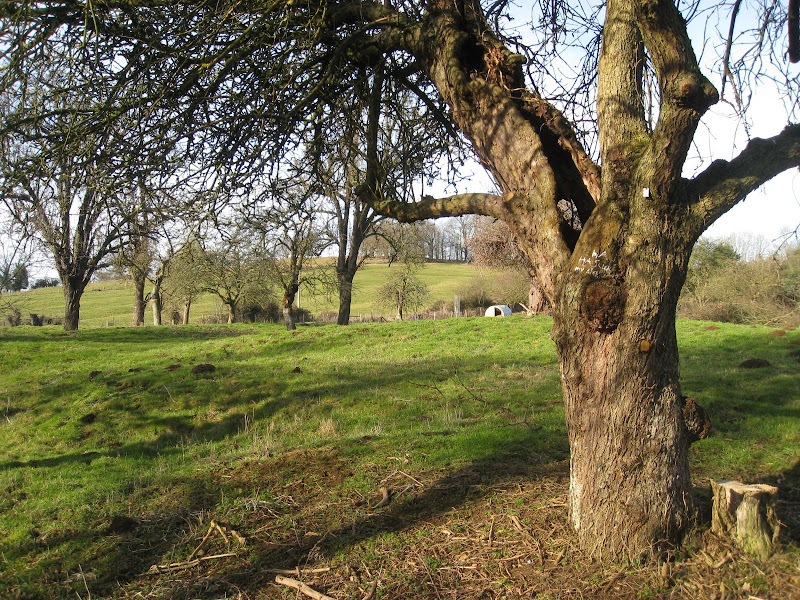

There are 47 old trees left in the orchard, many of great age and rich in veteran tree features that are so ecologically diverse. This is one of the reasons why traditional orchards are now a UK Biodiversity Action Plan 'priority' habitat. The one in the foreground here is almost completely hollow and would be a good place to look for Noble Chafer (Gnorimus nobilis) frass.


All the fruit trees populating the edge abutting Back End lane will be lost in the proposed development. That includes the three seen here in the foreground (the nearest is an ash). I'm not sure security lights will age so gracefully. A huge amount of soil will also need removing to flatten this section.


In 1994 there was a topographical survey of the site undertaken by the Cotswold Archaeological Trust. It found that the most significant archaeological feature of the site was the ridge and furrow earthworks that are likely to be of medieval origin and 'lend themselves to a visual appreciation of the medieval and later agricultural activity surrounding the settlement of Chipping Campden'. Orchards and woodlands are excellent places to see these agricultural fingerprints that are quickly eroded by mechanised farming methods.


Certain members of The Campden Society seem to have forgotten that its role is for promoting conservation and not development. Fortunately there are people in the town that appreciate that our heritage does not always come packaged in Cotswold stone - the group 'Caring for Campden' have been fighting to preserve the orchard, listing arguments against the initial parking justification. I can now add to their arguments my own: that from my experience of visiting and surveying the ecological aspects of traditional orchards, the Wold's End orchard is site of immense value.

Crucially, recent efforts have been made to restore the site, with many new trees on appropriate vigorous rootstocks that will ensure there is a new generation to replace those that die. A central position in a historic and popular town should allow school children, residents and the general public to be educated in the value of traditional orchards: the ecological value, their place as a legacy of our farming heritage and as a means of reconnecting an increasingly urbanised nation with biodiversity. Acres and acres of the countryside are monocultures of arable crops with very little variety or room for nature - why do the car parks and new houses have to be built on these rare fragments of land that have interest above and beyond a focus on productivity?


However, the future is not entirely gloomy for Wold's End orchard. Unlike the majority of traditional orchards in Britain, this one is not left unused. Chipping Campden School has rented the site on a 'peppercorn rent' (i.e. very small amount) and uses it as a practical space for their Environmental and Land-based Science GCSE and 'rural crafts' course. Children have helped to restore the orchard by grafting the existing varieties and caring for the Gloucestershire Old Spot pigs that have provided pork for the school canteen. 20 new apple trees, 2 pears and a walnut have been planted and trees have been pruned. Numerous fruit trees have been planted around the school as well.

Have a look at this article.

And if you can, go down and visit the orchard and make your own mind up. And get in touch with the Campden Society and get your views heard.

Tuesday, February 23, 2010

Pruning party 2010


It was a question we had all been asking ourselves: what can a dozen people armed with saws do to an old orchard in a day? Will the outcome be disastrous? Can the ecological and horticultural aims be kept in balance? Will the cider kill the work ethic? Perhaps more than anything we were blessed by the weather on a day fine enough to inspire even the most dendrophobic Londoner into considering all those water shoots and congested crowns.


Teaching people about pruning is difficult, and especially so with the unusual situation at Charingworth. Here Bramley apple trees on vigorous rootstocks have been commercially managed for over 70 years. We are now attempting to ease them into a less intensive management regime, whilst at the same time preserving all the valuable types of habitat that orchards can accumulate over time.

I started my friends off on a couple of trees I had already half-pruned. This eased them into the basics of dealing with the water shoots without too many confusing or important decisions to make.


The basic message was: clear the crown and lower branches from water shoots and then thin the majority of the rest, choosing a few well positioned shoots to take the vigour. Remove anything crossing or pointing back in. Easy, breezy, beautiful.


I was lucky to have Harry and Tommy back from the pruning weekend last year. It looks like Harry is giving some advice to Luca in this photo - knowledge sharing for fruit bearing!


We brought a load of well seasoned wood into the orchard to try and create a fire ferocious enough to consume the piles of sappy offcuts that have been created. I think the only workable solution will be to hire a mobile chipper for a day once the pruning is finished.


A "Blitzkrieg" campaign on tree 31.


I picked up twenty litres of medium sweet Prior's Tipple cider to keep the mood buoyant. Alongside hot Cumberland sausages with mustard and onion marmalade, this made for an idyllic lunch amongst the trees.


By the end of the day we had pruned five trees (shown here in pink). This was more than I had hoped for and it was so thrilling that everyone seemed to really get into it. This takes the total up to 27, which is over half way!

More importantly it allowed a few people to experience the beauty of old orchards first-hand. There is nothing quite like sitting in the arms of a pruned apple tree with a glass of cider to allow communion with, in James Russell's words, that "man-made Eden".

Tuesday, November 10, 2009

Betty Daffurn's orchard legacy at Kemerton


© Copyright David Hawgood and licensed for reuse under this Creative Commons Licence

The other day I went on a pilgrimage to Daffurn's community orchard in Kemerton. This is the cottage Betty lived in for 94 years. It was the first true community orchard I have visited and looked very carefully maintained. The area has a fantastically motivated and established Conservation Trust that owns several wildlife sites and oversees the management of some 1,280 acres of land around Bredon Hill. The orchard restoration work carried out by the Kemerton Conservation Trust recently received a significant amount of funding from the National Trust. If only all British villages were as well endowed with enlightened perspectives on farming and wildlife.


I think they may have snowdrops, wild daffodils(?) and bluebells in the orchard. To get a true feeling for any community orchard I think you need to meet some of the workers that maintain it. Unfortunately I didn't have enough time to prearrange such a visit, but the orchard in itself is very interesting as wildlife sanctuary and piece of local history. I look forward to them releasing the species lists for the orchard from the directory of 45,000 records for the local area!


No one has ever been killed by a sheep. They were doing a good job of keeping the sward down when I visited, which looked distinctly unimproved and herb-rich.

Sunday, October 4, 2009

Cleeve Prior cider weekend


My good friend (and boss) Jez is the man behind Prior's Tipple, a cider that uses fruit from old orchards in the village of Cleeve Prior, Worcestershire (see 15/8/09 post). Each year he hosts a cider making weekend where friends from across the country get together to pick and process fruit, camp amongst the trees and drink cider. The old orchards of Cleeve Prior are being used, and because of this they are admired, maintained and play an important role in reconnecting people with the natural world. Old orchards that have a use stand a far better chance of surviving.


There are several orchards in the village, and on the Saturday thirty of us moved between about five different sites collecting fruit. Prior's Tipple is made from a 'geographical blend' of fruit and thus although there is no exact recipe, the same trees are harvested from each year ensuring that a broadly consistent mix of apples goes into the press. You don't want the juice to be too sweet since it is often the sourer flavours that provide levels of complexity in the cider.


We picked three tonnes of fruit from this orchard. It had some fairly ancient trees in it, including a couple of perry pears like the one in the foreground here. Interestingly this one had really sweet fruit whereas I expected all perry pears to be quite bitter to taste.


You can't really shake a big tree from the ground, but climbing fruit trees is often sketchy. Everyone was in quiet agreement about one thing though- knocking the fruit down is far more fun than picking it up again off the floor!


A beautiful apple that Jez calls the 'still life' apple. Not sure about the real variety but this shouldn't be impossible to find out considering how unusual it is.


Many hands making light work of a haul of fruit the weight of which almost became scary. That's about a tonne in the van there.


The business end of proceedings; apples are 1) washed, 2) roughly chopped, 3) scatted into pulp, 4) organised into 'cheeses' and 5) pressed. The juice is filtered and collected in large tanks to begin fermentation.


I was really impressed by the work of the Cleeve Prior Heritage Trust. They got the villagers to club together and raised thousands of pounds to buy land in the village to save it from development or misuse. This is a photo of the Cleeve Prior Community Orchard and Parish Ponds, a nature reserve with old plum and apple trees and several fantastic ponds. It is a wildlife haven, with unimproved grassland that apparently has fantastic wildflowers in the summer (including pyramidal orchids). The ponds are thankfully free of fish and gaps in the orchard have been replanted with cider apple trees that we harvested, a diversification that keeps the orchards productive.


In a cavity in one of the old plum trees I found the frass of the Noble Chafer (Gnorimus nobilis)! Unmistakable lozenge shaped droppings of a very rare beetle. (I think these orchards have already been fully surveyed so sadly no glory to be claimed for that spot.)


This was in another orchard, mainly plum again. Jez provided many of the maiden cider-apple trees that have been used to replant the gaps. There were also a few much older standard apple trees such as the one pictured. We saw a Little owl flying across the grass and there were huge ant hills along the fenced edge.


Oh apple tree, we'll wassail thee
And hoping thou wilt bear,
For the Lord does know where we may go
To be merry another year.

To grow well and to bear well,
And so merrily let us be,
Let every man lift up his glass
And a health to the old apple tree,
Brave boys, and a health to the old apple tree.


(Traditional English wassailing song.)
Related Posts with Thumbnails