Showing posts with label Blenheim Orange. Show all posts

Friday, October 28, 2011

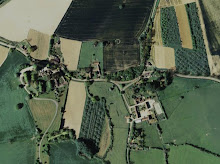
The surviving orchards of Ebrington


Looking down towards Chipping Campden from one of the only old cherry orchards left in this part of Gloucestershire. In this area, it's better to focus on what is left to preserve rather than dwell on what has been lost.


This is James Stanley, a farmer who lives locally to me. He looks after several fantastic old orchards that I spotted via Google Earth. Today he was kind enough to take me on a guided tour of his orchards and the weather couldn't have been better for it. This tree is a Blenheim Orange. I've encountered a few old ones like this - they're impressive trees and always recognisably by the gnarly bark. It's a tasty late dessert apple variety found in c. 1740 as a 'gribble' by a gardener, Mr Kempster, on the boundary wall of Blenheim Palace in Woodstock. (A 'gribble' is an apple tree that has germinated naturally from a pip in the countryside, in case you were wondering!).


It is a classic traditional orchard, with all the trees widely spaced on standard rootstocks that has enabled the tress to grow large enough to cope with cattle grazing for many years. James was telling me how he used to pick from all the trees using tall ladders and sell the fruit locally. Sadly now there is no market for the varieties except intermittent custom from local cider-makers. Hooray for cider, again!


This is an interesting tree. James has a whole row of these, with spectacular claret fruit. James' father used to call these "Devlins".


Looks can be deceiving though, as they taste pretty cardboardy and apparently only really sold during the war when everyone was short on options.


Beautiful perry pear trees again, reminiscent of an orchard in Bledington and my new friends Helmut and Monika's farm in Switzerland.


Because it has been so dry and sunny recently the trees have kept their leaves really well - look at the colour of this perry pear!


Sadly this orchard has a real issue with 'generational bias', like many traditional orchards. If they no longer have a commercial use then there is no incentive to 'gap up' when trees die and an orchard with no young trees will slowly fade away...


Is this Ebrington's last plum orchard?

Tuesday, November 24, 2009

Heavy machinary in the Charingworth orchards


Last Wednesday my neighbour John Langston brought his tractor to the orchards to help me do some grass mowing. It was such a beast that we couldn't take it between the trees but we managed to cut a few more open areas that were beginning to succeed to scrub. Flailing can be a destructive process, but it is probably the best way of dealing with large areas of really rough grass and brambles. For that afternoon at least, the crunching sound of the flail carried by the wind really was the sound of progress!


The lowest of these three 'before and after' shots shows the 'meadow area' at the back of the lower (1940s) orchard. It has always had a bad dock infestation that has made farming this patch impractical. However, I believe that chemical fertilizers have not been heavily used here and as a result there are already patches of Birdsfoot Trefoil and Meadow Vetchling that flourish in summer. Flailing will hopefully encourage these and prevent blackthorn, buddleia and poplar saplings from becoming dominant. I plan to seed some areas where the tractor has exposed soil with a wildflower mix and see whether anything establishes.


Here is a clearing in the 1920s orchard that we also flailed. I am planning to do some replanting in this area before Christmas. I am currently tempted by the idea of a couple of Blenheim Orange (likes clay) and an Orleans Reinette (fantastic eater, apparently) and perhaps some bittersweet varieites for cider. They have to be on M25 rootstocks though as I want them to grow BIG!

Tuesday, November 3, 2009

Conderton, Worcestershire: an orchard of national importance?


Today I braved some fairly angry rain storms to visit a big pear orchard in Conderton (near Tewksbury), Worcestershire. At several hectares in size, several hundered trees and over a century old, there's an awful lot to try and condense into a few photos. It is certainly one of the best orchards I have yet visited and perfectly illustrates the similarity of old traditional orchards to woodland pasture. Indeed, because of it's size and scale I don't expect there are many in the whole county to rival it, especially in terms of habitat diversity and potential for biodiversity. It is begging out for a full species inventory to be undertaken.


That hole was perfect for a Little owl and they love orchards like this one. This is also one of the first orchards I have documented that have had abundant mistletoe (Viscum album) in them. It just doesn't seem to be as common around Charingworth. Misletoe is interesting because it acts like a minature ecosystem supporting six invertebrate species that entirely rely on it.


One of these mistletoe-dependent species is the Mistletoe Marble moth, Celypha woodiana, a UKBAP species. You can detect it by looking for characterisitic damage done by the leaf-mining larvae to the leaves (but alas I did not know this until now and so did not check for it!). The other five species dependent on mistletoe are the weevil Ixapion variegatum (first recorded as a new British species in a Herefordshire orchard in 2000) and four ‘true bugs’ (belonging to the Order Hemiptera): the capsid bug Pinalitus visciola, the predatory Anthocoris visci, the Jumping Plant Louse Psylla visci, and Hypseloecus visci (discovered as recently as 2003 in Somerset).


How about that for a wildlife woodpile? An incredible spread. Fortunately there are also many dead trees that have been left standing as well. The orchard has an incredible range and volume of dead wood; standing, shaded, large logs, full fallen trees and even logs submerged in water. This provides much of the substrate for fungal and microbial decomposition, which is in turn exploited by a whole suite of insects that provide food for all the larger animals.


A lesser stag beetle I found underneath one of the large pear logs pictured.


Orchards often contain other structural features of the landscape preserved around or within them. This one had several very large old ash pollards (and one of field maple). These could house larger raptors and owls and add a different dimension of habitat complexity.


Only whole-dead trees like this provide enough appropriately decomposed wood to support the development of large beetles like the stag beetle, and some species of longhorn beetle and click beetle whose larvae can take seven years to develop.


I'm certainly no lichenologist, but every tree seemed to have a quite varied lichen community and traditional orchards like this are excellent lichen habitats with old trees and low chemical inputs.


What a fantastic orchard landscape that is. I'm betting on Blenheim Orange for the gnarly gentleman in the foreground. It seems to be a real bird haven too, for even though I went without any binoculars, I immediately saw two green woodpeckers take off with their characteristically undulating flight. I spotted many yellow meadow ant hills that they love to feed in. There were also clouds of fieldfare that were pestered by a sharking sparrowhawk at one point. I must make a concerted effort to contact the Overbury Estate and learn more about this special place.


Monday, October 12, 2009

An orchard from the 1890s at Girton College, Cambridge

I was in Cambridge today and headed up to Girton College on the bus to check out their orchards. The head gardener, Mr Robert Bramley helpfully filled me in on what is known of the Old Orchard and its history and upkeep. Planted in the 1890s to provide a supply of fruit for the College's kitchens, it has plum, pear, apple and cobnut trees with over thirty varieties. Its really beautiful- many of the original trees remain in good condition and the area is a haven for wildlife (including lichens apparently). The visit provided an invigorating contrast to the bland planting schemes and quick turnover borders that Cambridge Colleges can be tempted by in their courts.


Can you spot the treecreeper?


This tree in the foreground is a fine example of a Blenheim Orange. Note the characteristically gnarly bark that is reminiscent of some of those veteran trees from Mount Pleasant, Warwickshire. This variety should like the heavy clay in Charingworth.


Girton College has not been very pro-orchard in recent years. A quite extensive orchard was planted in 1948 as an alternative fruit source to the Old Orchard. Recently it was removed to allow for a 're-organisation' of their sports pitches. My friend Lester was at Girton at the time and signed a petition to try and stop this, but to no avail. I think the trees were all only semi-dwarfing and so its some consolation to think it wasn't a majestic orchard of standards. Fortunately the Old Orchard at Girton is rather more respected but it's frightening how little protection these places have currently have under British law.


The area highlighted in blue was the 1948 orchard circa 2006. Now it's a rugby pitch. Ouch.


I also met Sir David Attenborough who was in Borders for a book signing to promote his new book 'Life Stories'. I couldn't resist giving the Charingworth Orchard Trust a little plug and he said: 'Ancient orchards are very precious places'. Here here! I got really star-struck and nearly wandered out without paying for my book.

Monday, August 10, 2009

Mount Pleasant Orchard


Last Sunday morning I went to Mount Pleasant near Shipston-on-Stour, Warwickshire for a second visit to Roger and Gudrun's fantastic orchard there. At ~4 acres, this non-commercial family orchard has around 220 standard fruit trees and a total of 93 identified varieties of apple, plum, pear and walnut. There is the full range of fruit tree ages, from those planted last year to the original trees from the first planting in about 1850. In other words, its a real treasure trove!


There are several features that make this orchard exceptional, and one of these is the abundance of very ancient apple trees. A sensitive regime of yearly pruning has allowed these trees to become 'over mature' and survive into old age still producing a few good fruit. The veteran tree features found in these trees hold great ecological value and they also develop fascinating twisted shapes. These trees are all Blenheim Orange and probably date from when the orchard was originally all this variety (with a few perry pears as well). It's a local variety that seems to like the heavy clay and makes for delicious eating.


This plum tree is quite bizarre- it is actually made up of two different varieties. The lower branches to the left and right are a wild form of Yellow Bullace (-apparently it is the first tree in the whole orchard to blossom, filling the air with a beautiful almond scent) and the top of the tree is a Blue Pershore. I think that technically you describe the Yellow Bullace as having been 'cuckolded'. This occurred when the Blue Pershore seeded itself in the original tree's crown and then grew down through its trunk.


This eating apple is called a Domino and is unusual on account of its hardness. The apples lie whole on the grass until well into spring and are an invaluable late food source for the overwintering fieldfare.


This is a Russian apple called Emperor Alexander, and one of Roger's favourites.


The illusive and mysterious Orleans Reinette. I have been told by the head of the Cambridge Botanical Gardens that this is best eating apple he's ever tried. Definitely worth a taster in a couple of months...


A multipurpose variety of apple that dates from Roman times called the Quoining. It was still producing until it toppled over this year, so the photos on the right show the tree in 2004 and the strange shape of the fruit. Roger took a graft from the remaining shoots but unfortunately the apples on that look more like a Bramley. Perhaps a second attempt will yield better results.


The orchard has a yearly prune where certain trees are taken in to balance them and minimise toppling or splitting. Recently one of the big original perry pear trees looked like it might split, so here are the before and after pruning shots. Even though it may look quite severe, the tree will quickly recover. This regime of continued maintenance has enabled so many of the trees in this orchard to reach a great age and remain in good condition.


These lumps in the foreground are ant hills of the Yellow Meadow Ant (Lasius flavus) . These ants need a well grazed sward to survive. The size of these ant hills indicates that this land has not been cultivated for a very long time.


The dead wood habitat provided by the orchard is phenomenal. Pruning offcuts are stacked in various places, both beneath trees and in more open areas along the orchard edge. This has provided a great range and abundance of decomposing wood habitats that will support a great diversity of invertebrates. It is a common misconception to assume that wildlife woodpiles must be damp and shaded for maximum benefit- dead wood that is dry and sun-warmed represents and equally valuable and endangered substrate. Gudrun says she can remember seeing stag beetles in the past and the trunk of this perry pear (photographed on the right) shows some evidence of quite large larval bore holes.


This picture says a lot about how well this orchard is managed. By replanting whenever gaps have appeared there is a full range of tree ages, something that is so often lacking in traditional orchards in Britain. Roger takes cuttings from exiting old trees and re-grafts them onto vigorous (M25) rootstocks ensuring they will develop into full size standard trees. This way varieties are preserved and the orchards future is planned for.


Related Posts with Thumbnails