Showing posts with label dead wood. Show all posts

Saturday, July 3, 2010

Orchards and beekeeping with Charlie the jackdaw


On Thursday I was invited to a special orchardy event hosted by the Farming and Wildlife Advisory Group (FWAG) at Day's Cottage. My beekeeping guru Tanya was one of the main speakers, covering all aspects of the the longstanding relationship between orchards and bees. In this photo she is showing us the different components of an occupied hive (although it does look suspiciously like some kind of cult meeting). I also gave a short talk about orchard restoration - hold onto your hats people!


Beekeeping is crammed full of interesting facts and props and this makes it ideal for demonstrating. Look at the amazing glass-fronted display hive on that table. We all had to try to identify six different honeys by taste. They were: Cotswold garden honey (Tanya's), Salisbury Plain honey (florally diverse), Sicilian Eucalyptus honey (monofloral), English heather honey (bleak?), oil seed rape honey (lurid?) and New Zealand manuka honey (TCP++). I got two right but was impressed by the range of flavours.


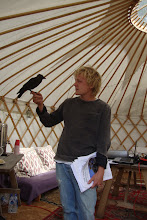
Here is Dave Kaspar, chairman on the Gloucestershire Orchard Group, and that chap on his shoulder is Charlie. Dave and Helen Brent-Smith have been raising him on cat food and he's now two months old. When I first arrived he came out of nowhere and landed on the FWAG lady's head and she freaked out, thinking he was a wild bird. In the other photo Dave is doing a demonstration of budding with a plum variety called Rivers' Early Prolific. Budding is another method of reproducing varieties, like grafting, only it's quicker and is done in the summer.


Here is the pommace left over from an earlier juicing, and see how it is studded with freshly germinated apple seedlings. Back when most farms had a press and made their own cider for the labourers, this stuff was often either fed to the pigs of spread on the fields. Farmers used this latter option as a way of generating new apple seedlings to use as rootstocks for established varieties. Every now and again one of these seedlings gave rise to a brand new variety, but sadly this source of new variation has been largely lost. Pips will not germinate unless they have been completely liberated from the apple flesh and 'scarified' by the cold of winter (or a fridge).


DEAD WOOD! THAT'S WHAT I'M TALKIN' ABOUT!


Here's Jonathan Briggs - you may recognise him from one of my previous posts - a mistletoe expert. He gave a fascinating talk all about this parasitic plant which is a key component of traditional orchard ecosystems. That sprig of mistletoe is emerging from an unusually thick branch. Day's Cottage is deep within mistletoe territory and it is abundant, but up in my corner of north Gloucestershire it is far less common and the nationwide distribution patterns are yet to be fully understood. I have had some success getting it established in Charingworth, but that's for another day...


Imagine this for a pub accessory. And look at his fantastic cool blue eye. Who's a good boy?! Jackdaws are corvids, a family that includes crows, jays and magpies, and they are very bright. They can use tools and have demonstrated self-awareness. Perhaps one day he will be tempted by the glint in your eye...

Friday, January 29, 2010

National Trust orchard training day at Day's Cottage: A tour of the orchards


Yesterday I went to Day's Cottage in Brookthorpe near Gloucester for an orchard training day. It was hosted by Dave Kaspar (GOG chairman) and Helen Brent-Smith at their Orchard Skills Centre on behalf of the National Trust. The day started with a tour of the orchards, the oldest of which was planted by Helen's great aunt in 1912. In this picture Dave is explaining that this dead tree is the most important tree in the orchard from an ecological viewpoint, due to the value of standing dead wood for invertebrates and the things that feed on them. As you can imagine, I was in my element!


This Newton Wonder apple tree was blown over only recently, but it is far from doomed. The tree will respond to this stress by putting out more roots and over time it will gradually re-align its canopy. I think it is healthy to encourage a more Victorian perspective on tree beauty, where the gnarls and warpings of time are celebrated and admired.


We also visited an old perry pear orchard which had several trees about 150 years old. We were shown how pear trees have very obvious graft marks even in old age. Perry pears have been recorded to live over 350 years, far longer than any apple. Dave explained how they are best left to their own devices and he regularly advises people not to try and prune them. I think the tree pictured is the variety Butt.


They have about 16 acres of orchards around the site that are being managed very sensitively for wildlife with mistletoe, bird and bat boxes, standing dead wood and no chemical inputs. This tree in the foreground has been toppled for a lot longer, and you can see it has recovered its posture quite admirably and still produces fruit. It reminds me of the Blenheim Orange trees at Mount Pleasant.


This is the museum orchard that was started around 15 years ago in partnership with Gloucestershire council and the GOG as a bank of Gloucestershire apple varieties. New varieties are still being found by people like Charles Martell so it's an ongoing project but it is old enough for the trees to be starting to take off. It's so exciting to think of returning in twenty years to see an established orchard and for an apple off each tree...


Here is my friend Freddie, a longstanding volunteer with the Charingworth Orchard Trust and Tanya, a beekeeper with her own company called Apples and Pears. We were pretty pleased to be able to purchase some perry for tasting later on!


The loot. Mistletoe for seeding at home, a perry pear maiden of the variety 'Bergamy' ("pronounce carefully") and superior grog.

Tuesday, November 3, 2009

Conderton, Worcestershire: an orchard of national importance?


Today I braved some fairly angry rain storms to visit a big pear orchard in Conderton (near Tewksbury), Worcestershire. At several hectares in size, several hundered trees and over a century old, there's an awful lot to try and condense into a few photos. It is certainly one of the best orchards I have yet visited and perfectly illustrates the similarity of old traditional orchards to woodland pasture. Indeed, because of it's size and scale I don't expect there are many in the whole county to rival it, especially in terms of habitat diversity and potential for biodiversity. It is begging out for a full species inventory to be undertaken.


That hole was perfect for a Little owl and they love orchards like this one. This is also one of the first orchards I have documented that have had abundant mistletoe (Viscum album) in them. It just doesn't seem to be as common around Charingworth. Misletoe is interesting because it acts like a minature ecosystem supporting six invertebrate species that entirely rely on it.


One of these mistletoe-dependent species is the Mistletoe Marble moth, Celypha woodiana, a UKBAP species. You can detect it by looking for characterisitic damage done by the leaf-mining larvae to the leaves (but alas I did not know this until now and so did not check for it!). The other five species dependent on mistletoe are the weevil Ixapion variegatum (first recorded as a new British species in a Herefordshire orchard in 2000) and four ‘true bugs’ (belonging to the Order Hemiptera): the capsid bug Pinalitus visciola, the predatory Anthocoris visci, the Jumping Plant Louse Psylla visci, and Hypseloecus visci (discovered as recently as 2003 in Somerset).


How about that for a wildlife woodpile? An incredible spread. Fortunately there are also many dead trees that have been left standing as well. The orchard has an incredible range and volume of dead wood; standing, shaded, large logs, full fallen trees and even logs submerged in water. This provides much of the substrate for fungal and microbial decomposition, which is in turn exploited by a whole suite of insects that provide food for all the larger animals.


A lesser stag beetle I found underneath one of the large pear logs pictured.


Orchards often contain other structural features of the landscape preserved around or within them. This one had several very large old ash pollards (and one of field maple). These could house larger raptors and owls and add a different dimension of habitat complexity.


Only whole-dead trees like this provide enough appropriately decomposed wood to support the development of large beetles like the stag beetle, and some species of longhorn beetle and click beetle whose larvae can take seven years to develop.


I'm certainly no lichenologist, but every tree seemed to have a quite varied lichen community and traditional orchards like this are excellent lichen habitats with old trees and low chemical inputs.


What a fantastic orchard landscape that is. I'm betting on Blenheim Orange for the gnarly gentleman in the foreground. It seems to be a real bird haven too, for even though I went without any binoculars, I immediately saw two green woodpeckers take off with their characteristically undulating flight. I spotted many yellow meadow ant hills that they love to feed in. There were also clouds of fieldfare that were pestered by a sharking sparrowhawk at one point. I must make a concerted effort to contact the Overbury Estate and learn more about this special place.


Friday, October 23, 2009

Wonderful dead wood for wildlife


I made this woodpile today out of old plum tree wood. It is tailored to suit the Noble Chafer (Gnorimus nobilis) with a large surface area facing south to ensure the wood is warmed as much as possible by the sun, thus aiding the development of the larvae (it should be good for all sort of other insects as well). Really looking forward seeing the first adult beetle hopefully next summer.


There are two fully dead apple trees located in clearings within the 1920s orchard, this being one of them. They are fantastic habitat for insects and I hope to leave them untouched during the restoration. There are not enough examples of large exposed dead trees within the British countryside and as a result many specialist creatures have suffered.


I think this is a type of wasp, but any further than that I don't know. It was on one of the dead trees in the upper orchard.

Monday, August 10, 2009

Mount Pleasant Orchard


Last Sunday morning I went to Mount Pleasant near Shipston-on-Stour, Warwickshire for a second visit to Roger and Gudrun's fantastic orchard there. At ~4 acres, this non-commercial family orchard has around 220 standard fruit trees and a total of 93 identified varieties of apple, plum, pear and walnut. There is the full range of fruit tree ages, from those planted last year to the original trees from the first planting in about 1850. In other words, its a real treasure trove!


There are several features that make this orchard exceptional, and one of these is the abundance of very ancient apple trees. A sensitive regime of yearly pruning has allowed these trees to become 'over mature' and survive into old age still producing a few good fruit. The veteran tree features found in these trees hold great ecological value and they also develop fascinating twisted shapes. These trees are all Blenheim Orange and probably date from when the orchard was originally all this variety (with a few perry pears as well). It's a local variety that seems to like the heavy clay and makes for delicious eating.


This plum tree is quite bizarre- it is actually made up of two different varieties. The lower branches to the left and right are a wild form of Yellow Bullace (-apparently it is the first tree in the whole orchard to blossom, filling the air with a beautiful almond scent) and the top of the tree is a Blue Pershore. I think that technically you describe the Yellow Bullace as having been 'cuckolded'. This occurred when the Blue Pershore seeded itself in the original tree's crown and then grew down through its trunk.


This eating apple is called a Domino and is unusual on account of its hardness. The apples lie whole on the grass until well into spring and are an invaluable late food source for the overwintering fieldfare.


This is a Russian apple called Emperor Alexander, and one of Roger's favourites.


The illusive and mysterious Orleans Reinette. I have been told by the head of the Cambridge Botanical Gardens that this is best eating apple he's ever tried. Definitely worth a taster in a couple of months...


A multipurpose variety of apple that dates from Roman times called the Quoining. It was still producing until it toppled over this year, so the photos on the right show the tree in 2004 and the strange shape of the fruit. Roger took a graft from the remaining shoots but unfortunately the apples on that look more like a Bramley. Perhaps a second attempt will yield better results.


The orchard has a yearly prune where certain trees are taken in to balance them and minimise toppling or splitting. Recently one of the big original perry pear trees looked like it might split, so here are the before and after pruning shots. Even though it may look quite severe, the tree will quickly recover. This regime of continued maintenance has enabled so many of the trees in this orchard to reach a great age and remain in good condition.


These lumps in the foreground are ant hills of the Yellow Meadow Ant (Lasius flavus) . These ants need a well grazed sward to survive. The size of these ant hills indicates that this land has not been cultivated for a very long time.


The dead wood habitat provided by the orchard is phenomenal. Pruning offcuts are stacked in various places, both beneath trees and in more open areas along the orchard edge. This has provided a great range and abundance of decomposing wood habitats that will support a great diversity of invertebrates. It is a common misconception to assume that wildlife woodpiles must be damp and shaded for maximum benefit- dead wood that is dry and sun-warmed represents and equally valuable and endangered substrate. Gudrun says she can remember seeing stag beetles in the past and the trunk of this perry pear (photographed on the right) shows some evidence of quite large larval bore holes.


This picture says a lot about how well this orchard is managed. By replanting whenever gaps have appeared there is a full range of tree ages, something that is so often lacking in traditional orchards in Britain. Roger takes cuttings from exiting old trees and re-grafts them onto vigorous (M25) rootstocks ensuring they will develop into full size standard trees. This way varieties are preserved and the orchards future is planned for.


Tuesday, August 4, 2009

Portabello crossroads orchard, Warwickshire

This is a beautiful orchard associated with an old farm on the Fosse Way in Warwickshire. Many of the trees are well over 50 years of age, including several of considerable girth. The grassland underneath is also very rich in wildflower species.


Note the Selfheal (Prunella vulgaris) in the foreground.


Standing dead trees are a fantastic habitat for insects and birds, but are often tidied away. Leaving them standing preserves this precious contributor to the diversity of your orchard.


One of the larger trees, although I have no idea about the variety...


A Brown Argus butterfly (Plebeius agestis) basking in the sun on the fringe of the orchard. Old orchards are great for butterflies since they combine an open canopy with many of their foodplants and nectar sources, as long as the sward beneath is rich in plant species.


A fantastic open cavity in the massive trunk of a large tree. Perfect access point for saproxylic invertebrates such as stag beetles, certain hoverflies and the Noble Chafer (Gnorimus nobilis). Also potential for bats roosting above.


In half an hour my plant tally for the orchard pasture included:

Selfheal (Prunella vulgaris),
Red Clover (Trifolium pratense- pink, pictured above),
Meadow Vetchling (Lathyrus pratensis),
Agrimony (Agrimonia eupatoria- yellow, pictured above),
Lady's Bedstraw (Galium verum),
Meadow buttercup (Ranunculus acris),
Knapweed (Centaurea nigra),
Red Bartsia (Odontites verna),
Silverweed (Potentilla anserina),
Ribwort Plantain (Plantago lanceolata),
and the grasses,
Meadow Barley (Hordeum secalinum) and,
Meadow Foxtail (Alopecurus pratensis).

Pretty impressive since these were just some of the obvious species that I could identify, indicating that the pasture has had very little inputs from fertilizer or herbicides. This sward greatly increases the ecological 'value' of the site.


I love finding gnarly old trees like this. Nothing worse than the indignity of being propped up.

Sunday, July 19, 2009

The value of dead wood in orchards

One of the most interesting aspects of the two orchards is the abundance of standing and fallen dead wood- a nationally scarce habitat important for many rare insects, especially beetles. For example there are apparently around 700 species of saproxylic beetle found in mainland Britain. It will be exciting to see what turns up...


Piles of old prunings at the base of many trees combined with cavities provide a range of rotting wood habitats.


The somewhat tragic end to a vast apple tree's life in the 1940s orchard. Its all about allowing these fallen giants to decay gracefully.

Whole standing-dead trees. There are two of these in the 1940s orchard (another can be just seen behind the one in the foreground of this photo). These are particularly valuable as the wood rots from the inside out, providing a range of stages of decomposition. The rotting of this wood is facilitated by fungi and various micro-organisms that convert the wood into substances that can be digested by a range of insect species, since very few insects can actually digest dead woody tissues directly.
Related Posts with Thumbnails