

On Thursday I was invited to a special orchardy event hosted by the Farming and Wildlife Advisory Group (FWAG) at Day's Cottage. My beekeeping guru Tanya was one of the main speakers, covering all aspects of the the longstanding relationship between orchards and bees. In this photo she is showing us the different components of an occupied hive (although it does look suspiciously like some kind of cult meeting). I also gave a short talk about orchard restoration - hold onto your hats people!

Beekeeping is crammed full of interesting facts and props and this makes it ideal for demonstrating. Look at the amazing glass-fronted display hive on that table. We all had to try to identify six different honeys by taste. They were: Cotswold garden honey (Tanya's), Salisbury Plain honey (florally diverse), Sicilian Eucalyptus honey (monofloral), English heather honey (bleak?), oil seed rape honey (lurid?) and New Zealand manuka honey (TCP++). I got two right but was impressed by the range of flavours.


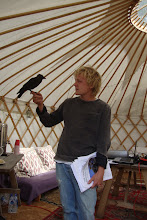
Here is Dave Kaspar, chairman on the Gloucestershire Orchard Group, and that chap on his shoulder is Charlie. Dave and Helen Brent-Smith have been raising him on cat food and he's now two months old. When I first arrived he came out of nowhere and landed on the FWAG lady's head and she freaked out, thinking he was a wild bird. In the other photo Dave is doing a demonstration of budding with a plum variety called Rivers' Early Prolific. Budding is another method of reproducing varieties, like grafting, only it's quicker and is done in the summer.

Here is the pommace left over from an earlier juicing, and see how it is studded with freshly germinated apple seedlings. Back when most farms had a press and made their own cider for the labourers, this stuff was often either fed to the pigs of spread on the fields. Farmers used this latter option as a way of generating new apple seedlings to use as rootstocks for established varieties. Every now and again one of these seedlings gave rise to a brand new variety, but sadly this source of new variation has been largely lost. Pips will not germinate unless they have been completely liberated from the apple flesh and 'scarified' by the cold of winter (or a fridge).

DEAD WOOD! THAT'S WHAT I'M TALKIN' ABOUT!

Here's Jonathan Briggs - you may recognise him from one of my previous posts - a mistletoe expert. He gave a fascinating talk all about this parasitic plant which is a key component of traditional orchard ecosystems. That sprig of mistletoe is emerging from an unusually thick branch. Day's Cottage is deep within mistletoe territory and it is abundant, but up in my corner of north Gloucestershire it is far less common and the nationwide distribution patterns are yet to be fully understood. I have had some success getting it established in Charingworth, but that's for another day...


Imagine this for a pub accessory. And look at his fantastic cool blue eye. Who's a good boy?! Jackdaws are corvids, a family that includes crows, jays and magpies, and they are very bright. They can use tools and have demonstrated self-awareness. Perhaps one day he will be tempted by the glint in your eye...


 var sc_project=4892462;
var sc_invisible=0;
var sc_partition=57;
var sc_click_stat=1;
var sc_security="2008a49a";
var sc_text=2;
var sc_project=4892462;
var sc_invisible=0;
var sc_partition=57;
var sc_click_stat=1;
var sc_security="2008a49a";
var sc_text=2;
