Showing posts with label bees. Show all posts

Saturday, July 3, 2010

Orchards and beekeeping with Charlie the jackdaw


On Thursday I was invited to a special orchardy event hosted by the Farming and Wildlife Advisory Group (FWAG) at Day's Cottage. My beekeeping guru Tanya was one of the main speakers, covering all aspects of the the longstanding relationship between orchards and bees. In this photo she is showing us the different components of an occupied hive (although it does look suspiciously like some kind of cult meeting). I also gave a short talk about orchard restoration - hold onto your hats people!


Beekeeping is crammed full of interesting facts and props and this makes it ideal for demonstrating. Look at the amazing glass-fronted display hive on that table. We all had to try to identify six different honeys by taste. They were: Cotswold garden honey (Tanya's), Salisbury Plain honey (florally diverse), Sicilian Eucalyptus honey (monofloral), English heather honey (bleak?), oil seed rape honey (lurid?) and New Zealand manuka honey (TCP++). I got two right but was impressed by the range of flavours.


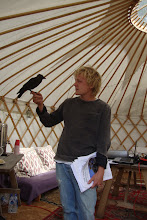
Here is Dave Kaspar, chairman on the Gloucestershire Orchard Group, and that chap on his shoulder is Charlie. Dave and Helen Brent-Smith have been raising him on cat food and he's now two months old. When I first arrived he came out of nowhere and landed on the FWAG lady's head and she freaked out, thinking he was a wild bird. In the other photo Dave is doing a demonstration of budding with a plum variety called Rivers' Early Prolific. Budding is another method of reproducing varieties, like grafting, only it's quicker and is done in the summer.


Here is the pommace left over from an earlier juicing, and see how it is studded with freshly germinated apple seedlings. Back when most farms had a press and made their own cider for the labourers, this stuff was often either fed to the pigs of spread on the fields. Farmers used this latter option as a way of generating new apple seedlings to use as rootstocks for established varieties. Every now and again one of these seedlings gave rise to a brand new variety, but sadly this source of new variation has been largely lost. Pips will not germinate unless they have been completely liberated from the apple flesh and 'scarified' by the cold of winter (or a fridge).


DEAD WOOD! THAT'S WHAT I'M TALKIN' ABOUT!


Here's Jonathan Briggs - you may recognise him from one of my previous posts - a mistletoe expert. He gave a fascinating talk all about this parasitic plant which is a key component of traditional orchard ecosystems. That sprig of mistletoe is emerging from an unusually thick branch. Day's Cottage is deep within mistletoe territory and it is abundant, but up in my corner of north Gloucestershire it is far less common and the nationwide distribution patterns are yet to be fully understood. I have had some success getting it established in Charingworth, but that's for another day...


Imagine this for a pub accessory. And look at his fantastic cool blue eye. Who's a good boy?! Jackdaws are corvids, a family that includes crows, jays and magpies, and they are very bright. They can use tools and have demonstrated self-awareness. Perhaps one day he will be tempted by the glint in your eye...

Sunday, June 27, 2010

A Winnie the pooh daydream: bees, drones, queens and HONEY


My bee guru Tanya supervised another peek into my bee colony last week. This is the 'wild' colony that I managed to capture in my bait hive in the 1920s orchard. Since the colony is about to have a population explosion we added another story onto the hive (called a 'super') and hopefully it is from this that we will be able to harvest honey. And check out the suits...(could I bee any hotter?)!


Unfortunately to get into the hive we had to disturb this wild comb somewhat, but it provided the perfect opportunity to have a really nosey snoop around their magnificent wax world. You can see a cross-section through the brood comb and inside these cells are the white developing larvae. Along the top edge of the top photo the comb is for a different use - it has honey and pollen (the darker brown stuff) stored and this is both a food source for the workers and developing young. Do they have it on toast, you may well ask?


Look how delicately sculpted the cells are. This close up shows the sedimentation of pollen produced as different bees contribute their tiny parcels collected from a range of plants with different coloured pollen.


Whenever you open a hive and disturb the bees they tend to congregate and do this special nosier wing-fan action. This is their way of calling in any disorientated bees who have gotten lost or wandered off.


I know what you're thinking: who's this handsome lad? He's a male bee (or 'drone') and slightly larger than the female workers. A proportion of each colony is made out of drones (even though all of the workers are female) because no colony can reproduce without a fertilized queen. He was skulking on his own on one of the frames. Pull your wing out son and get pollinating!


We made some frames to go into the brood box and encourage the bees to build their comb on them. In this photo I am helping Tanya attach this wild comb onto a frame before returning it to the hive. Ideally we should have filled the box with frames very early on and then the bees would have had no choice but to build comb on them.

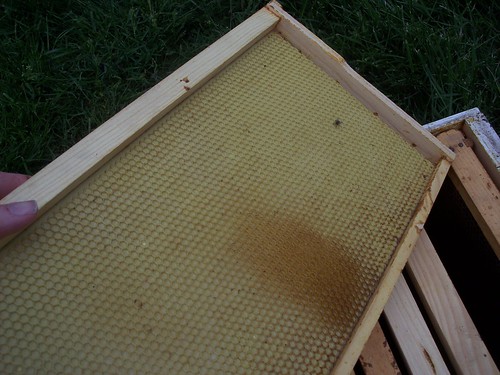
The advantage of the removable frame system is two-fold: Firstly, you can take them out to check up on their progress. Secondly, it is less energetically expensive for the bees to build comb on a frame with a sheet of wax that has the hexagonal cell pattern embossed into it (a 'foundation'). Wax takes about six times more energy than honey to make so this foundation reduces the amount of energy the bees spend on wax and thus they can produce more honey.


That metal grid thing is called a 'queen excluder'. It separates the brood box at the base with the 'super' above and has gaps that are just too narrow for the queens abdomen to fit through. This prevents her from laying eggs in the super, keeping it just for honey and pollen. Royal discrimination.


Picnicking with winnie the pooh? I got to take home some of the honey comb and it tasted goo-ood.

Sunday, June 6, 2010

Inspecting the hives...I'm covered in bees!

At the end of April my beekeeping guru Tanya came over and helped me to install two bait hives, one in each orchard. The aim was to try and capture a wild colony when they start to swarm around this time of the year. It seemed like a real long shot, but amazingly I started to see bees going in and out of one of the hives about two weeks ago. So on Thursday evening we went back to have a peek at the colony and see how far they had got with their empire...


This is Tanya carefully lifting the lid on the hive in the 1920s orchard. That beautiful construction is wild bee comb and represents the natural form of a bee comb, the home of the colony. It is so pale because it has been made recently - over time apparently it will become browner with the build up of propolis. Unfortunately, comb like this is more tricky to manage than comb built on the removable frames you can see to the front of the hive. Ideally we would have filled the hive with these frames before they managed to build this natural comb and thus forced them to build on the frames. Still, what a wonder to behold!


Most commercial beekeepers would break up the natural comb into flat sections and attach it using string or elastic bands to the frames, thus allowing the colony to be managed much more easily. Since I don't have to be as efficient we decided on a compromise where we left the bulk of the natural comb but filled the rest of the hive with frames for them to move onto as the colony grows.


Here I am using the smoker to move the bees around and try and prevent any from being squashed. Smoke irritates them and they shy away from it. Amazingly, the bees didn't seem to get too bothered with our meddling and they didn't try and sting us. Phew!


We took a small piece of comb out to have a taste. The cells on one side are filled with nectar and the darker cells contain pollen which you can also eat. The bees have not yet started converting the nectar into honey. They do this by adding an enzyme and reducing the water content. This allows them to store energy supplies since honey will not ferment (it is in fact the only type of food that never goes off in pure form!). When the colony gets bigger I can add another story to the hive and sustainably harvest some honey periodically. We ate it with the first strawberries of the year. Very decadent!

Sunday, May 16, 2010

Bait hives for honey bees


My friend Tanya is a natural beekeeper- that is, one that does not use chemicals and tries to encourage as natural a life cycle as possible for her colonies. She has loaned me two bait hives, one for each of my orchards in Charingworth. Bait hives are the empty first story of a hive that has been used by a colony previously. Theoretically, the smell of residual amounts of propolis and wax attracts scout bees that are on the look out for a new home for a naturalised colony that is ready to swarm. This swarm then may colonise the hive, and as it grows you can gradually increase the size of the beehive to accommodate them. The bees will then help pollinate the orchard effectively, and you can harvest HONEY from them! Mmmm.


Have a look at this secret glade I made in the 1940s orchard last week using my strimmer. It is quite magical to be enclosed by blossoming trees on all sides.

Sunday, November 15, 2009

'Wild' honey bees in the lower orchard at Charingworth


Today I was in the 1940s orchard clearing brambles away from the fearsomely shrouded branches of tree 40. I found a surprisingly active colony of honey bees in the south facing base of one of the trees nearby. Honey bees are not actually native to Britain. There are 'feral' populations of the European honey bee, a domesticated form of the bee Apis mellifera that originated in eastern tropical Africa. Beekeepers and orchards have a long history of symbiosis, with the beehives traditionally brought into the orchard in late spring for the blossom. This way the pollination of the blossom is maximised, helping ensure a good apple crop for the farmer and lots of nectar for the bees to make honey with.


I remember that the cavity had had unoccupied combs in it last winter and has clearly been repossessed by the bees. The photo on the left shows this comb in November 2008, with the one on the right taken today. Honey bees are not doing well in Britain currently. They are suffering from a range of new diseases, including the parasitic varroa mite that has spread viruses throughout wild and captive bee colonies.


The press often deal with these issues rather clumsily, confusing the causes of the decline in feral honey bee populations with those of the truly native bumblebee (23 species) and solitary bee (~250 species). The basic reason for the decline in most of our true native bee species has little to do with diseases- agricultural intensification has removed the majority of our species-rich grasslands and thus there are no longer enough nectar-rich plants to support bumblebee colonies and solitary bees (this photo shows a unimproved lowland flood meadow near Bledington, with abundant clover and birdsfoot trefoil). A lack of appropriate nest site habitats is also probably a factor limiting some bumblebee and solitary bee species. I went on a bumblebee walk on Salisbury Plain in August and met Damian who is interested in all these issues and has his own charity dedicated to helping bees.

Sunday, September 20, 2009

A giant walnut tree in Wiltshire


This beautiful old Walnut tree is in the grounds of my friends home in Wiltshire. It is the largest I have ever seen and had a bees nest half way up it in one of the cavities. What a beauty.
Related Posts with Thumbnails